Was A Record of Shameless Deeds Propaganda or History?

A dramatic editorial-style image for an article about A Record of Shameless Deeds by William Le Queux. In the foreground, a wooden desk holds aged newspapers, handwritten documents, a fountain pen, an ink bottle, and a lit candle casting a warm glow. A copy of the book stands beside wartime headlines reporting atrocities and conflict. Beyond the desk, a devastated cityscape stretches into the distance beneath dark smoke-filled skies, with ruined buildings and a church spire silhouetted against the light. Elegant serif typography asks, “Was A Record of Shameless Deeds Propaganda or History?” with the subtitle, “Truth, Fear, and the Stories We Choose to Believe.” The overall mood is reflective, atmospheric, and contemplative, exploring the blurred boundary between historical truth and wartime persuasion.

Was *A Record of Shameless Deeds* a genuine historical record, or a piece of wartime propaganda designed to shape public opinion? The answer is more complicated than many modern readers might expect. This article explores the blurred boundary between history and persuasion during the First World War, examining how fear, patriotism, and uncertainty influenced the stories people believed. Along the way, it asks a broader question that remains relevant today: when emotions run high and information is incomplete, how do we decide what is true?

What Moby Dick Understands About Obsession

A solitary figure stands at the bow of a nineteenth-century whaling ship, gazing across a vast, misty ocean towards a distant horizon illuminated by soft golden light. The scene is rendered in muted blues and greys, creating a reflective, atmospheric mood. Elegant serif typography reads “What Moby-Dick Understands About Obsession,” reinforcing the article’s exploration of fixation, purpose, and the dangers of becoming consumed by a single goal.

Most people think *Moby-Dick* is a novel about a whale.

In reality, it may be one of literature's most searching examinations of obsession.

Captain Ahab's pursuit of the white whale is dramatic, but the emotions driving him are surprisingly familiar. The desire to prove ourselves, the refusal to let go, the belief that one achievement, one answer, or one victory will finally make everything make sense. Herman Melville understood that obsession rarely arrives looking dangerous. More often, it arrives disguised as purpose.

This article explores why *Moby-Dick* remains such a powerful reflection on ambition, identity, and the thin line between determination and self-destruction.

Alice’s Adventures in Wonderland: Is It Still Worth Reading After 160 Years?

An atmospheric literary scene inspired by Alice's Adventures in Wonderland. An open antique book rests on a wooden table beside a pocket watch, stacked books, a steaming teacup, and a softly glowing oil lamp. Beyond an open doorway, a winding garden path leads through a dreamlike Wonderland landscape filled with flowers and warm golden light. Elegant typography reads, "Alice's Adventures in Wonderland: Still Worth Reading After 160 Years?" creating the mood of a thoughtful literary essay exploring the enduring appeal of Lewis Carroll's classic novel.

More than 160 years after its publication, *Alice's Adventures in Wonderland* continues to capture the imagination of readers around the world. But is Lewis Carroll's strange tale of talking animals, impossible conversations, and curious adventures still worth reading today? This article explores what modern readers may discover beneath the book's playful surface, from questions of identity and curiosity to the enduring challenge of making sense of a confusing world.

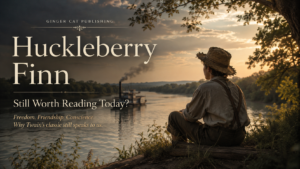
Why Is Huckleberry Finn Still Worth Reading Today?

A literary featured image for an article about Adventures of Huckleberry Finn by Mark Twain. At sunset, a young boy in a straw hat sits on a riverbank overlooking a wide river and a distant paddle steamer. Warm golden light reflects across the water while trees frame the scene. Elegant serif typography reads “Huckleberry Finn: Still Worth Reading Today?” with the subtitle “Freedom. Friendship. Conscience. Why Twain’s classic still speaks to us.” The image evokes reflection, adventure, and moral growth in a calm, atmospheric style.

Why do readers continue returning to *Huckleberry Finn* more than a century after it was written? Beneath the adventure lies a thoughtful story about friendship, moral courage, and the challenge of following your conscience. Discover why Mark Twain's classic still feels surprisingly relevant today.

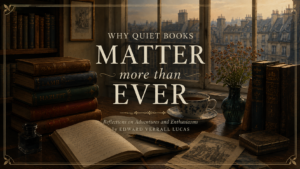
Why Quiet Books Matter More Than Ever

Featured image for a literary article titled Why Quiet Books Matter More Than Ever. A warmly lit vintage writing desk sits beside a window overlooking old European rooftops at dusk. Antique books, an open journal with a fountain pen, loose illustrated papers, a teacup, flowers in a vase, and an ink bottle create a calm, reflective atmosphere. Elegant serif typography overlays the scene, with the title prominently displayed in the centre and a subtitle referencing Adventures and Enthusiasms by Edward Verrall Lucas. The overall mood is thoughtful, literary, and quietly inviting.

There is something slightly strange happening in modern reading life. At the exact moment the world has become louder, faster, more distracted, and more relentlessly demanding of our attention, many readers are quietly drifting toward books that seem to do…

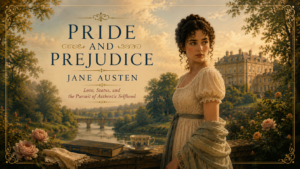
What Makes Pride and Prejudice Feel So Timeless?

Atmospheric literary illustration for Pride and Prejudice by Jane Austen featuring a thoughtful Regency-era woman standing beside a river terrace at sunset, with a grand English manor, stone bridge, roses, and elegant serif typography in warm muted tones.

There are some classic novels that survive mostly because they are historically important. People admire them, study them, and occasionally feel guilty for not finishing them. Then there are books like Pride and Prejudice. Books people return to willingly. Books…

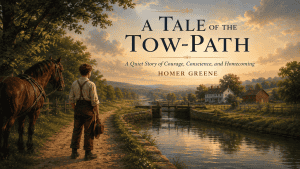
Is A Tale of the Tow-Path a Good Classic for Beginners?

For many modern readers, beginning to explore classic literature can feel strangely intimidating. There is often a quiet worry beneath the curiosity. Will the language feel difficult? Will the story move too slowly? Will the book feel emotionally distant from…

What Makes a Book a Classic?

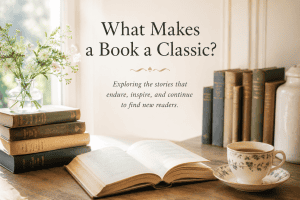
A warm, inviting reading nook featuring an open book on a wooden table, surrounded by stacks of vintage hardback books. Soft daylight streams through a nearby window, illuminating a vase of delicate white flowers and a floral teacup filled with tea. In the centre of the image, elegant text reads: “What Makes a Book a Classic? Exploring the stories that endure, inspire, and continue to find new readers.” The overall atmosphere is calm, reflective, and literary.

Every year, thousands of books are published. Some become hugely popular for a while. Some dominate bestseller lists. Some are talked about constantly online. And then, after a few years, many quietly disappear. Others somehow survive. Readers continue discovering them…

Returning to The Secret Garden as an Adult

A Secret Garden

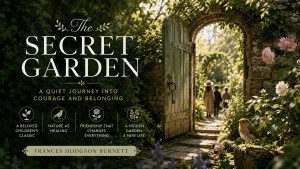
Few children’s classics continue to live in the imagination quite like The Secret Garden. More than a century after Frances Hodgson Burnett first published the novel in 1911, readers still return to it during periods of loneliness, exhaustion, grief, burnout,…

The Beginning of Sherlock Holmes Still Feels Surprisingly Fresh

Text A Study In Scarlett with Sherlock Holmes silhoette

More than a century after its publication, A Study in Scarlet continues to attract new readers, spark debate, and inspire endless adaptations. It introduced Sherlock Holmes and Dr. Watson to the world in 1887, helped define modern detective fiction, and…

Reading Wuthering Heights as a Modern Reader

Some books survive because they are comforting. Others survive because they refuse to become tame. Wuthering Heights belongs firmly in the second category. More than 175 years after its publication, Emily Brontë’s only novel continues to unsettle readers with its…